


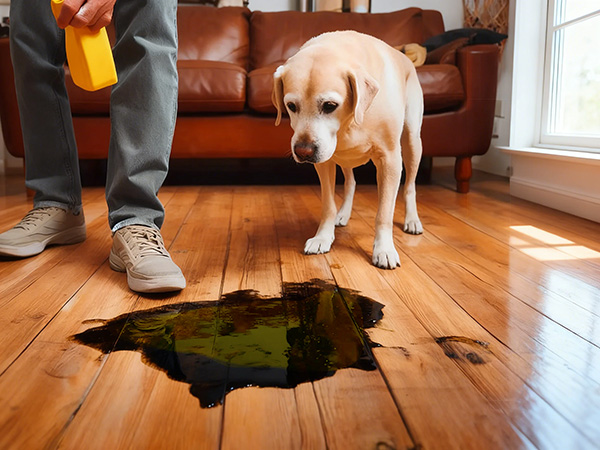
We get it. You're staring at that dark, stubborn stain on your beautiful hardwood floor. Maybe it's been there for months. Maybe you just discovered it under the rug. Either way, you've already tried everything Pinterest suggested, and now you're wondering: Is this floor salvageable, or am I looking at thousands in replacement costs?
Here's what no one tells you upfront: That black stain isn't just sitting on your floor—it's actually a chemical burn that goes deep into the wood. The uric acid in pet urine has reacted with the tannins in your oak flooring, permanently altering the wood's structure. This is why your cleaning attempts haven't worked.
But before you panic about costs, let's walk through your real options. As flooring specialists who've helped thousands of homeowners navigate this exact problem, we'll show you the three paths forward—from the $20 DIY attempt to strategic replacement options that won't break your budget.
Quick Navigation:
- First: Assess Your Actual Damage (30-Second Test)
- Option 1: The $20 Fix That Sometimes Works
- Option 2: The Spot Repair Strategy (When One Board is Ruined)
- Option 3: The Smart Replacement (Getting More for Less)
- The Pet-Proof Solution: What to Choose Next Time
- Real Cost Comparison: Repair vs. Replace
- Your Top Questions Answered
First: Assess Your Actual Damage (30-Second Test)
Before spending any money or time, let's figure out what you're really dealing with. Not all dark spots are created equal, and knowing the difference can save you hundreds of dollars.

The Touch Test:
- Surface stain only: If the finish feels smooth and intact, you might be in luck. The stain may be sitting between the finish and wood.
- Finish is cloudy or flaking: The urine has compromised your polyurethane. This needs addressing but isn't catastrophic.
- Wood feels rough or "punky": The wood fibers are damaged. This is permanent damage that cleaning won't fix.
- Multiple spots or large areas: If you're seeing a pattern of damage, spot repairs become less cost-effective.
The Reality Check:
If the stain has been there more than a few weeks, it's likely permanent. Pet urine doesn't just stain—it chemically alters the wood. Think of it like bleaching fabric: once those fibers change, they don't change back.
Option 1: The $20 Fix That Sometimes Works
Success rate: About 30% for black stains, 60% for dark brown stains
If your stain is relatively new (less than 6 months) and you want to try saving the board, here's the only method that has a chance of working. Fair warning: This can lighten your wood significantly, potentially creating a different problem.

What You'll Need:
- Hydrogen peroxide (3%, from any pharmacy) - $3
- White terry cloth rags - $5
- Plastic wrap - $2
- Fine-grit sandpaper (220 grit) - $5
- Polyurethane finish to reseal - $15
The Process:
- Lightly sand the area to remove any finish. This lets the peroxide penetrate.
- Saturate a white rag with hydrogen peroxide and place it over the stain.
- Cover with plastic wrap to keep it from drying out.
- Check every 2 hours. The peroxide is bleaching the wood—too long and you'll have a white spot instead of a black one.
- Once lightened, let it dry completely (24 hours).
- Reseal with polyurethane to protect the bare wood.
Why This Often Fails:
The stain typically goes deeper than the peroxide can reach. You might lighten the surface only to have the darkness show through again once you apply finish. If this happens, move to Option 2 or 3.
Option 2: The Spot Repair Strategy (When One Board is Ruined)
If the DIY method didn't work but the damage is limited to a few boards, replacement of individual planks is your most economical option. This typically costs $200-500 versus $3,000+ for a full room.
The Smart Approach:
Don't buy a whole box of expensive flooring for a small repair. Instead:
- Option A: Buy Cabin Grade, Engineered Blue Label, or Ultility Grade "Shorts" - These are shorter pieces perfect for repairs, costing 50-70% less than standard planks.
- Option B: Look for clearance hardwood bundles of the same species. You don't need perfection for a patch job.
- Option C: Pull boards from a closet and patch that area with new (mismatched) wood where no one will see.
DIY vs. Professional Installation:
- DIY Cost: $50-150 for materials + your time
- Professional Cost: $300-500 for a small patch
- Skill Level Required: Intermediate (you'll need a circular saw and patience)
-

Option 3: The Smart Replacement (Getting More for Less)
Sometimes, the smartest financial decision is strategic replacement—especially if you have multiple damaged areas or aging floors that were due for updating anyway.
The Budget Reality Check:
Traditional hardwood replacement costs $8-15 per square foot installed. For a 200 sq ft room, that's $1,600-3,000. But here's what most people don't realize: You can get genuine hardwood for the price of good laminate if you know where to look.
The Cost-Saving Strategy:
- Buy direct from liquidators (like us) instead of retail: Save 40-60%
- Choose "Cabin Grade" or "Rustic" for authentic character at half the price
- Consider engineered hardwood—same real wood surface, better price point
- DIY the installation if it's a floating floor: Save $3-5 per sq ft
Hidden Benefit:
If you're dealing with pet stains, you're likely dealing with pet odor too. No amount of cleaning will eliminate urine crystals that have penetrated the subfloor. Fresh flooring isn't just about looks—it's about having a truly clean, odor-free home.
The Pet-Proof Solution: What to Choose Next Time
If your pet is still with you (and we hope they are!), let's talk about making a smarter choice for your next floor.
The Uncomfortable Truth:
Traditional solid hardwood and pets are a challenging combination. Even with the best training, accidents happen. Instead of living in fear of the next accident, consider these alternatives:
Option A: Waterproof Luxury Vinyl Plank (LVP)
- Pros: 100% Waterproof Vinyl, can't absorb odors, looks like real wood, easy to clean
- Cons: Not real wood (affects home value differently), can show scratches
- Cost: $2-4 per sq ft for quality USA-made options
- Best for: Active pets, elderly pets, or homes with multiple animals
Option B: Engineered Hardwood with Aluminum Oxide Finish
- Pros: Real wood with an Engineered Hardwood Core, superior scratch resistance, can handle occasional accidents if cleaned quickly
- Cons: Still vulnerable to prolonged moisture exposure
- Cost: $3-6 per sq ft from liquidators
- Best for: Homes with well-trained adult dogs or cats
Option C: Sealed Concrete or Tile (For Problem Areas)
- Pros: Completely impervious to pet damage
- Cons: Cold, hard on joints, less homey feel
- Cost: $3-8 per sq ft installed
- Best for: Mudrooms, pet areas, or transition zones
Real Cost Comparison: Repair vs. Replace
Let's talk real numbers for a typical 12' x 15' room (180 sq ft) with multiple pet stains:
| Option | DIY Cost | Professional Cost | Time to Complete | Success Rate |
|---|---|---|---|---|
| Sand & Refinish Entire Floor | $300-500 | $900-1,500 | 3-4 days | 50% (stains often remain) |
| Replace Damaged Boards Only | $100-300 | $500-800 | 1-2 days | 90% (if color matches) |
| Install New Hardwood (from liquidator) | $540-900 | $1,080-1,800 | 2-3 days | 100% (fresh start) |
| Install Waterproof LVP | $360-720 | $900-1,440 | 1-2 days | 100% (pet-proof) |
Key Insight: When you factor in the risk of refinishing failure and the time investment, replacing with discounted materials often makes more financial sense than extensive repair attempts.
Your Top Questions Answered
Q: I've heard vinegar and baking soda work for pet stains. Why didn't you mention them?
A: These are great for fresh accidents but useless for set-in black stains. Vinegar can actually damage your floor's finish, and baking soda only absorbs surface moisture. For black stains that have chemically altered the wood, you need either bleaching agents (like hydrogen peroxide) or replacement.
Q: Can I just paint over the stain?
A: Unfortunately, no. The urine has likely sealed the wood pores with crystallized salts. Paint won't adhere properly and will peel. Plus, the odor often remains trapped underneath.
Q: Will homeowner's insurance cover pet damage to floors?
A: Typically, no. Pet damage is considered preventable maintenance, not sudden accidental damage. However, if the pet damage led to other issues (like subfloor rot causing structural problems), you might have partial coverage. Check your specific policy.
Q: How long do I have before a pet accident becomes a permanent stain?
A: On sealed hardwood, you have 10-30 minutes before it starts penetrating. On worn or unsealed floors, damage begins immediately. The black discoloration typically appears within 24-48 hours as the chemical reaction occurs.
Q: Is the black stain harmful to my family or pets?
A: While unsightly, the stain itself isn't toxic once dry. However, the urine crystals can harbor bacteria and create odors that trigger repeat marking by pets. For hygiene and to prevent behavioral issues, addressing the stain is important.
Q: What if the smell is my main problem, not the appearance?
A: If urine has penetrated to the subfloor, no amount of surface treatment will eliminate odor completely. You'll need to either: (1) Replace the affected boards and seal the subfloor with a primer like KILZ, or (2) Replace the flooring entirely. Enzyme cleaners can help with surface odor but won't reach deep penetration.
Ready to Move Forward?
Whether you're attempting a repair or ready for fresh flooring, we can help. Browse our selection of:
- Cabin Grade Hardwood - Perfect for repairs and budget-conscious full rooms
- Waterproof LVP - Pet-proof and worry-free
- Engineered Hardwood - Real wood with better moisture resistance
Questions about matching your existing floor or choosing the right pet-friendly option? Our flooring experts are here to help. Expect very low sales pressure, just honest advice from people who understand the realities of living with pets.


