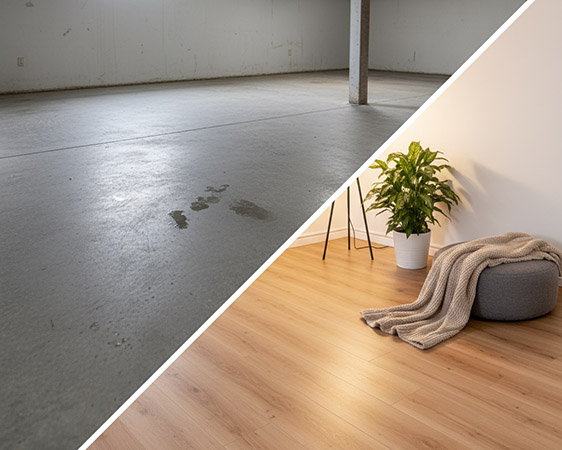
If you're sitting in a house with a slab foundation wondering whether you can get real wood floors, the answer is yes. Homeowners can recover up to 118 percent of their investment on new wood flooring, and the best engineered hardwood flooring for basement renovations makes that math even sweeter.
We've spent over half a century making real wood floors something regular folks can actually afford. That means we know exactly which engineered products work below grade and which ones will have you calling us back in six months.
Key Takeaways
| What You Need to Know | The Straight Answer |
|---|---|
| Can you put real wood in a basement? | Yes, engineered hardwood is built for below-grade installation because its layered core handles moisture and temperature shifts better than solid wood. |
| What does it cost? | First Quality engineered planks start at $1.99 per square foot at our store. Big-box stores start the same stuff at $4.50. |
| How hard is installation? | Click-lock systems cut labor time by more than half. A DIYer with basic tools can handle a basement floor over a weekend. |
| Engineered vs. vinyl plank? | Vinyl is cheaper upfront but adds zero resale value. Engineered hardwood gives you real wood and real money back at sale time. |
| What about moisture? | Always test your concrete subfloor for moisture and lay down a vapor barrier before installing any wood product below grade. |
| Where does your wood come from? | American-made engineered hardwood from mills in Kentucky and Georgia. Same mills that supply the big-name brands, minus the big-box markups. |
The Moisture Resistance in Engineered Wood Floors is Key
Here's the deal with basements. You've got concrete, you've got moisture, and you've got temperature swings that would make solid wood cup and buckle like a rodeo bull.
Engineered hardwood solves all three problems because it's built in layers. The top layer is real wood, the same species you'd get in a solid board. The core underneath is cross-grained plywood or high-density fiberboard that resists the expansion and contraction that kills solid wood below grade.
Now, 71.98% of the hardwood flooring market has shifted to engineered products, and it's not because of marketing hype. It's because the stuff actually works in places where solid wood flat-out fails. Kitchens, basements, multi-level homes, you name it.
Remember, cheap flooring is our middle name, but we're not going to sell you something that won't hold up. We sell engineered hardwood because it's the right product for the job, not because it's the trendy pick.
If you're weighing your options between engineered hardwood and luxury vinyl plank, let's talk about that. Vinyl is waterproof and cheap, sure. But it's also plastic. It doesn't add a dime to your home's appraised value, and most discerning buyers can spot it from across the room.
Engineered hardwood gives you actual wood underfoot. It appraises as real wood. It smells like real wood when you cut it. And when you go to sell, 79 percent of homeowners agree that wood floors are the superior choice for increasing a property's resale value. That's real money in your pocket.
How to Choose the Best Wood Flooring
Have you ever noticed that almost all of the eggs in the grocery store are grade A, Large? That's because the grocery store only buys the eggs that fit a narrow spec. Anything that's too big, too small, or has a speck on the shell gets sorted out.
Hardwood grading works the same way. The big box stores want everything made easy, so their buyers acquire the same product at the same specs, month after month. They want First Quality boards that all look identical, with no knots, no mineral stain, no character.
Here's how the grades break down for engineered hardwood:
- First Quality (Blue Label): The cream of the crop. No defects, consistent color, full-length boards. This is what most homeowners want for a basement renovation.
- Cabin Grade: Boards with knots, wormholes, mineral streaks, and shorter average lengths. We sell a ton of this to flippers who want real wood at killer value prices. The defects are character, not flaws.
- Utility Grade / Shorts: The shortest boards and anything with manufacturing imperfections. Great for small spaces like powder rooms or basements where you're cutting a lot of pieces anyway.
- Seconds: Product that didn't pass the mill's First Quality inspection. Might have a finish skip or a slightly off color. We purchase seconds, overstock, and discontinued varieties from big companies and sell these boards for a fraction of what you would typically pay for a wood floor.
For a basement renovation, we typically recommend First Quality engineered hardwood. Basements are already fighting a reputation for being damp and dark. You want clean, bright, consistent boards that make the space feel finished and intentional.
That said, if you're a flipper working on a tight budget, Cabin grade engineered hardwood can absolutely work in a basement. You just need to know what to expect in the box and set expectations with your buyer. A salesperson must know what to expect to find in the box and be able to represent it well.
Width Matters in Basements
Wide plank flooring, anything 5 inches or wider, makes a basement look bigger and more open. Narrow planks like 3.25-inch red oak have their place, but in a below-grade space with low ceilings, wide planks draw the eye outward and create the illusion of square footage.
Most of our best-selling engineered products for basements come in 7-inch to 7.5-inch widths. That's the sweet spot where you get the modern wide-plank look without paying premium prices.
Our Top Picks
We're going to walk you through our top products for basement renovations in 2026. These are all American-made, all First Quality, and all priced at wholesale because our base price is already wholesale to everyone. We don't have a contractor tier.
1. Noble's Way Winter River 7.25" First Quality
This is our number-one pick for basement renovations, hands down. Noble's Way Winter River is a 7.25-inch wide plank in white oak with a light, textured finish that brightens up any below-grade space.
At $1.99 per square foot, this is killer value. You're getting First Quality American-made engineered hardwood for less than what some stores charge for laminate. The light color reflects what little natural light you might have in a basement, and the wire-brushed texture hides everyday wear.
Best for: Basements with limited natural light. The light tone opens up the space.
2. Canyon Elements Cedar Creek 7.25" First Quality
Canyon Elements Cedar Creek brings a medium brown tone that hits the sweet spot between too light and too dark. At $2.49 per square foot, it's a reliable, classic wood look that works in any basement renovation.
This is the board we recommend when a homeowner wants something warm but not dark. The 7.25-inch width gives you that modern wide-plank look, and the First Quality grade means no surprises in the box.
Best for: Finished basements used as family rooms or entertainment spaces. The medium tone hides dirt and wears well in high-traffic areas.
3. Duet Rhett's Desire 7.5" First Quality
Duet Rhett's Desire is our statement plank. It's 7.5 inches wide with a dark stain that makes a basement feel like a high-end man cave or home theater. At $2.79 per square foot, you're getting a premium look for a fraction of what the big-box stores charge.
Dark floors in basements work when you've got good artificial lighting. If your basement has recessed cans or track lighting, this floor will look like a million bucks. If you're working with a single bare bulb, stick with Noble's Way.
Best for: Basements used as home theaters, bars, or man caves with controlled lighting.
4. Oak Plank Red Oak Natural (Engineered)
Sometimes you don't need a fancy name. Engineered Oak Plank in Red Oak Natural at $2.29 per square foot is the workhorse of basement flooring. It's classic, it's clean, and it goes with everything.
Red oak natural is the color most people picture when they think "hardwood floor." It's been the standard for fifty years, and it's not going anywhere. For a basement renovation where you want timeless appeal, this is your board.
Best for: Basements where the goal is a seamless transition from the hardwood upstairs. Red oak natural matches almost anything.
5. Ambient Oak Gunstock
Ambient Oak Gunstock is a 7-inch wide plank with a distressed, wire-brushed finish. The gunstock color is a rich brown with amber undertones that pairs beautifully with stone walls and fireplaces in basement renovations.
The wire-brushed texture is practical for basements because it camouflages scratches and dents from kids, pets, and furniture moving. If your basement is going to be a play area, this is a smart pick.
Best for: High-traffic basements with kids and pets. The distressed finish wears like iron.
Engineered vs. Vinyl Plank Flooring for Basement Renovations
We sell both products, so we're not going to pretend one is universally better. But we will give you The Straight Answer on when to choose each.
| Feature | Engineered Hardwood | Vinyl Plank |
|---|---|---|
| Material | Real wood veneer over plywood/HDF core | 100% synthetic (PVC or WPC) |
| Water resistance | Moisture-resistant, not waterproof | Fully waterproof |
| Resale value | Appraises as real wood, adds value | Does not appraise as permanent improvement |
| Lifespan | Up to 100 years with proper care | 10 to 20 years typical |
| Price (our store) | $1.99 to $2.79 per sq ft | $1.29 to $2.49 per sq ft |
| Can be refinished? | Yes, 1 to 2 times depending on veneer thickness | No, must be replaced |
Here's how we break it down. If your basement has an active water problem, vinyl plank is the pragmatic choice. It won't warp, it won't cup, and it won't grow mold.
But if your basement is dry and you're finishing it as real living space, engineered hardwood is the better investment. Two-thirds of homeowners specify hardwood as their top choice for a "dream home," and that preference translates directly to resale value.
Finding Discount Flooring That Saves Real Money
Let's do some math. Say your basement is 500 square feet. At the big-box store, entry-level engineered hardwood click-lock planks start at $4.50 per square foot. That's $2,250 before tax, underlayment, or trim.
Price spread between budget-friendly and premium options for basement renovations.
At our store, Noble's Way Winter River is $1.99 per square foot. That same 500 square feet costs $995. You save $1,255 on the flooring alone. That's real money, and it's exactly why we've spent over half a century making real wood floors something regular folks can actually afford.
Now, the premium engineered hardwood options marketed specifically for basement durability can reach $7.99 per square foot at specialty retailers. Same 500 square feet would cost you $3,995. We're selling you the same engineered construction, the same real wood veneer, for a quarter of that price.
How do we do it? It's simple. He calls up Ted at ReallyCheapFloors.com and says, "Ted, I need an outlet for 100,000 sq ft of Cabin grade each month." That's the whole game, my friends. We buy direct from the mills in Somerset, Kentucky and Dalton, Georgia. No distributor markup, no showroom overhead, no middleman.
Or we buy overstock when a big retailer cancels an order. The mill has 40,000 square feet of First Quality product sitting on the floor and nowhere to ship it. Ted gets the call, we make a deal, and that product ends up on our website at wholesale pricing for everyone.
We also stock Oak Lakes Red Oak Natural and other value-engineered options for homeowners who want to stretch every dollar. If you're renovating a basement on a tight budget, these are the products that make it possible.
Install Guide
What I will tell you is this: do not let the installation method distract you from the more important question, which is the quality of the engineered hardwood flooring itself.
That said, installation matters, especially in a basement. Here's what you need to know about putting engineered hardwood over concrete.
Step 1: Test the Concrete
Concrete always looks dry on the surface. It's not. Concrete wicks moisture from the ground below, and that moisture will destroy a wood floor if you don't account for it.
Buy a calcium chloride moisture test kit for about $30 at any hardware store. Tape it to the floor per the instructions and wait 72 hours. If the reading comes back above 3 pounds per 1,000 square feet per 24 hours, you need a more aggressive moisture mitigation system before installing any wood product.
Step 2: Install a Vapor Barrier
Even if your moisture test passes, lay down a vapor barrier. This is non-negotiable for basement installations. Use a 6-mil polyethylene sheet or a premium underlayment with a built-in moisture barrier.
Overlap the seams by 6 inches and tape them with vapor-barrier tape. Run the barrier up the wall 2 inches on all sides. This creates a containment envelope that stops ground moisture from reaching your floor.
Step 3: Choose Your Installation Method
For basement installations over concrete, you have two practical options:
- Click-lock floating floor: The easiest DIY method. Planks snap together and float over the vapor barrier. No glue, no nails. This is what most homeowners choose, and with modern click-lock systems, the installation goes fast.
- Glue-down: More permanent and feels more solid underfoot. Use a premium urethane adhesive rated for below-grade installation. This method costs more in materials and requires more skill, but it's the gold standard for basement wood floors.
Do not nail or staple engineered hardwood to a concrete subfloor. It doesn't work, and you'll ruin your boards trying.
Step 4: Acclimate the Wood
Stack the boxes in the basement for 48 to 72 hours before installation. Open the boxes, cross-stack the boards, and let them adjust to the temperature and humidity of the space. This prevents gaps and buckling after installation.
Skip this step and you'll be sorry. Wood moves, and if you install it straight off the truck, it'll expand or contract after it's down and you'll have gaps between planks that look terrible.
Tips for House Flippers: Killer Value on Basement Hardwood Flooring
If you're flipping houses, the basement is where you make your margin. Most flippers throw cheap carpet down there and call it done. That's a mistake.
A finished basement with real wood flooring adds square footage to your appraisal. Appraisers measure finished below-grade space differently than above-grade, but it still adds value, and wood floors signal quality to buyers.
Here's our playbook for flippers:
- Buy First Quality, not Cabin grade. Flippers love Cabin grade for the price, but in a basement, you want clean boards that signal "new construction." First Quality at our wholesale prices costs barely more than Cabin grade at retail.
- Stick to light colors. Light floors make basements feel bigger and brighter. Noble's Way Winter River at $1.99 is your go-to flipper's flooring for basements.
- Use click-lock installation. No glue means no cleanup, no curing time, and no fumes. You can install on Saturday and stage furniture on Sunday.
- Order 10% extra. Basements have weird angles, utility closets, and support posts. You'll waste more material than you think cutting around obstacles.
- Photograph the moisture test. Keep documentation showing the basement was dry when you installed. Savvy buyers and their home inspectors will ask.
A flipper's secret weapon is knowing where to source materials. We've had flippers drive from three states away to pick up a pallet of engineered hardwood from our warehouse. The savings on a 500-square-foot basement renovation can cover the cost of the rest of the finishes.
That's not an exaggeration. If you save $1,250 on the floor, that pays for the drywall, paint, and trim in the same basement. One smart purchase decision funds the rest of the project.
Conclusion
The best engineered hardwood flooring for basement renovations in 2026 balances three things: moisture resistance, real wood value, and a price that doesn't eat your entire renovation budget. Engineered hardwood checks all three boxes when you buy it at the right price from the right source.
We've been doing this for over fifty years from our base in Dalton, Georgia, with products milled in Somerset, Kentucky. We know which engineered floors survive below grade and which ones don't. The products we listed above are the ones we'd put in our own basements.
Remember, cheap flooring is our middle name, but we're not selling you cheap quality. We're selling you First Quality American-made engineered hardwood at wholesale prices because that's the business model that's kept us going since day one. No big-box markups, no contractor tiers, no games.
If you're ready to start your basement renovation, request a free sample from any of the product pages above. We'll ship it to your door so you can see the color and texture in your own space before you commit. That's how it ought to work.
Frequently Asked Questions
Can you install engineered hardwood flooring in a basement?
Yes, engineered hardwood is specifically designed for below-grade installation. Its cross-grained core resists the moisture and temperature changes that make solid wood fail in basements. Always use a vapor barrier over concrete subfloors.
What is the best engineered hardwood flooring for basement renovations in 2026?
The best engineered hardwood flooring for basement renovations combines a moisture-resistant core, First Quality grading, and a price that fits your budget. Our top pick is Noble's Way Winter River at $1.99 per square foot because it's bright, wide-plank, and American-made.
Is engineered hardwood better than vinyl plank for basements?
It depends on your goals. Vinyl plank is fully waterproof and cheaper, but it doesn't add resale value. Engineered hardwood gives you real wood, adds appraisal value, and can last up to 100 years. If your basement is dry, engineered hardwood is the better long-term investment.
How much does engineered hardwood cost for a basement renovation?
At our store, First Quality engineered hardwood for basement renovations starts at $1.99 per square foot. For a typical 500-square-foot basement, that's under $1,000 for the flooring. Big-box stores charge $4.50 or more for comparable products.
Do I need a moisture barrier under engineered hardwood in a basement?
Yes, always. Even if your concrete looks and feels dry, it wicks moisture from the ground below. A 6-mil polyethylene vapor barrier or premium underlayment with a built-in moisture barrier is mandatory for any wood flooring installation below grade.
Can I install engineered hardwood over a concrete basement floor myself?
Absolutely. Click-lock floating engineered hardwood is one of the most DIY-friendly installations available. You need a vapor barrier, a saw for cutting planks, spacers for the perimeter expansion gap, and a tapping block. Most homeowners can finish a basement floor in a weekend.
How long does engineered hardwood last in a basement?
With proper installation over a vapor barrier and normal maintenance, engineered hardwood can last decades in a basement. The top wood veneer can be refinished once or twice depending on thickness, extending the life even further. Wood floors have a potential lifespan of 100 years as a long-term investment.