


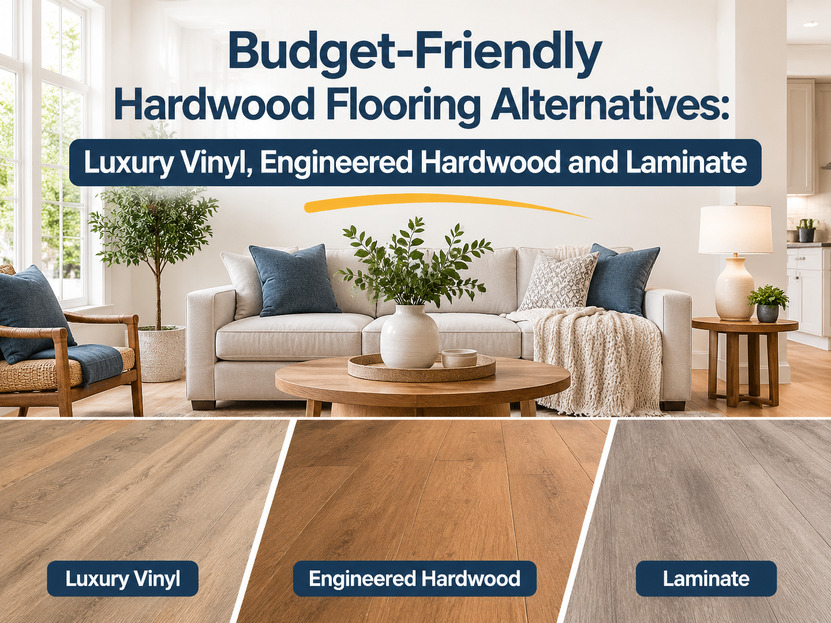
Budget-friendly hardwood flooring alternatives can give you the wood look without the price or upkeep of traditional hardwood. We’ll compare laminate, luxury vinyl plank, engineered hardwood, bamboo, cork, tile, and a few ways to save on real wood, with the drawbacks up front.
Key Takeaways
| What you want | A practical place to start |
|---|---|
| A hard-wearing wood look for a busy home | Compare luxury vinyl plank flooring for a waterproof core and floating installation options. |
| A budget-friendly floating floor | Browse laminate flooring for wood-look boards with a tough printed surface. |
| Real wood with more dimensional stability than solid hardwood | Compare engineered hardwood, which has a real wood surface over a layered core. |
| The lowest-cost real wood option | Look at unfinished shorts, cabin grade, and mill run flooring, but expect more variation and shorter boards. |
| Floors that art bathroom kitchen living room friendly | Choose tile or a water-resistant vinyl floor, and remember that seams and edges still need protection from standing water. |
| A DIY-friendly installation | Click-lock laminate and many floating vinyl inspiration posts on instagram are among the simpler options for a careful DIYer. |
Compare luxury vinyl, and laminate, tile, with other wood-look floors
Laminate flooring uses a printed wood image under a clear wear layer, attached to a fiberboard core. It can look convincing from standing height, but the image does not have the one-of-a-kind grain variation, repair options, or refinishing potential of real wood.
Luxury vinyl plank (LVP) has a printed wood design and a flexible or rigid vinyl construction, depending on the product. Claire’s Cove Weathered is listed at $1.79 per square foot and has a 12 mil wear layer, embossed texture, attached pad, and floating installation.
Laminate often has a firmer, more wood-like feel than thin vinyl, while LVP is usually quieter and softer underfoot. Neither material can be refinished like solid wood, so a deeply damaged area usually calls for a plank replacement rather than sanding.
- Wood-look tile: Porcelain or ceramic tile handles moisture well and resists scratches, but it feels hard and cold underfoot. Grout lines remain visible, and tile installation takes more skill and tools than a click-lock floor.
- Bamboo flooring: Bamboo is a grass, not a wood, but it can provide a natural plank appearance. Strand-woven bamboo is compressed into a dense floor, though product construction and finish affect its durability.
- Cork flooring: Cork feels warmer and softer underfoot than tile or laminate. It can dent under heavy furniture and needs suitable surface protection in areas where spills are common.
- Painted plywood: This can be a low-cost DIY finish for a utility space, but visible seams, surface wear, and plywood movement make it a rough substitute for a factory-finished floor.
For a water-prone room, compare waterproof vinyl flooring options, but do not confuse a water-resistant surface with a floor system that can keep water out at every seam. Wipe spills promptly, and after a leak, dry the area and inspect the edges, underlayment, and subfloor for trapped moisture.
Engineered hardwood flooring gives you a real wood surface
Engineered hardwood floors come with a real wood wear layer bonded to a layered core. Engineered floors are built with a construction to handle seasonal humidity changes better than solid wood. Engineered floors are still wood flooring at the end of the day, don't treat them like a waterproof floor.
Made from engineered white oak, Western Plank Tide has an 8.25-inch width, a 3.5 mm wear layer, wire-brushed texture, and low-gloss finish. Its listed price is $2.99 per square foot, and nail, staple, glue, and floating installation methods are available.
Can engineered wood be sanded and refinished? Sometimes. The thickness of the real-wood wear layer determines whether sanding is practical and how much material a floor can lose; refinishing suitability varies by floor.
For a rental, a quick remodel, or a home with muddy dog paws and laundry baskets crossing the room, weigh the real-wood look against the care it needs. A hard finish helps, but the shiny finish doesn't hold up in a “life happens” type of home.
Find lower-cost real wood in shorts, cabin grade, and mill run
If you want real wood, you do not always need to pay first-quality prices. Cabin grade, mill run, and shorts can reduce the material cost, but expect more knots, color variation, shorter boards, or other character marks.
Unfinished shorts are the short-board option, listed at $0.99 per square foot. Because they are unfinished, budget for sanding and finishing as well as installation.
Country Strip, listed at $2.49 per square foot, is another option. Hickory Lakes is solid hickory; call for current pricing and available grade.
It ain’t all pretty. Expect lots of short pieces and you will not be disappointed, but those short boards can add sorting and installation time.
Compare the full installed cost, not just the plank price
How much does 1,000 square feet of flooring cost? Multiply the material price per square foot by 1,000 for a starting point, then add waste, subfloor preparation, underlayment, transitions, trim, removal, disposal, and installation labor.
For example, the flooring material for 1,000 square feet of Claire’s Cove would come to $1,790, using its listed price of $1.79 per square foot, before those added project costs. That number is a starting estimate, not a complete installed quote.
Measure the actual floor area, then account for cuts and the room layout when figuring material needs. A hallway with several doorways or an angled room produces more offcuts than a simple rectangle.
Remember, cheap flooring is our middle name, and this guide is going to show you how to get killer value without the big-box markups. Compare the final project total, not just the price printed beside a plank.
Choose flooring for kitchens, pets, and busy entryways
Which wood-look flooring is best for a kitchen or entryway? Vinyl plank and porcelain tile are strong choices for rooms that see frequent spills, wet shoes, and tracked-in dirt. Tile resists surface wear, while vinyl feels warmer and less hard underfoot.
Waterproof vinyl protects the plank itself, but water can still reach the subfloor through seams, doorways, edges, or damaged areas. Clean up spills promptly and do not leave standing water to test the floor’s limits.
For pets and children, compare the wear layer, surface texture, and repair method. A textured finish can make small scuffs less obvious, while a very dark or glossy surface tends to show dust, scratches, and paw marks more clearly.
Laminate can take everyday abrasion well, but water at joints can swell a fiberboard core. Wood-look tile resists scratches and water, yet dropped dishes can break and the hard surface can be unforgiving on knees and paws.
Plan the subfloor and installation before you order
Which hardwood alternative is easiest to install yourself? Click-lock laminate and floating LVP are typically the most DIY-friendly because their boards connect without nailing or gluing each plank to the subfloor. Engineered hardwood may also float, while solid hardwood usually needs a nail-down installation and wood-look tile takes careful setting and grouting.
A floating floor still needs a sound, clean, dry, and flat base. Uneven spots can make joints flex or separate, and moisture from concrete can damage the flooring or become trapped underneath.
Use the underlayment suited to the floor and subfloor. Some products include an attached pad, while others need separate underlayment; do not stack extra padding beneath a floor designed for a specific support layer.
Remove loose material, secure squeaky subfloor panels, and address high or low areas before installing. When you find moisture, a soft subfloor, or a floor that slopes or moves, get testing or a professional assessment before covering the problem.
An overlay can be a poor choice when there are height changes at doorways, loose existing planks, soft flooring, or moisture concerns.
Judge wood-look realism and everyday comfort
Look at samples in the room where the floor will go, at different times of day. Window light, warm bulbs, and wall color can change how a plank’s tone reads.
Compare several planks together. Look for repeated printed knots, identical grain patterns, shallow texture, and edge details that make the floor read like separate boards instead of one repeating picture.
Real wood has naturally changing grain, knots, and color from board to board. Printed flooring can look very realistic, but the image repeats and a damaged printed layer cannot be sanded back into new wood.
Comfort matters too. Cork and vinyl tend to feel warmer and softer than tile, while laminate and tile can sound harder underfoot, especially on an upper floor. Rugs and suitable underlayment can reduce some noise, but they cannot change a rigid floor into a soft one.
Maintain, refinish, and repair the floor you choose
Laminate and Vinyl care guides all need regular sweeping or light vacuuming to keep the floors looking good year round. Apply a damp mop weekly, don't use a soaking wet one. Avoid harsh abrasives that can damage the wear surface.
Solid hardwood can usually be sanded and refinished when its remaining thickness allows it. Engineered hardwood depends on the real-wood wear layer, while laminate and printed vinyl do not have a wood surface to refinish.
Floating planks can often be replaced by opening the floor from an edge or carefully removing a damaged board, depending on the layout. Glue-down vinyl repairs take more work, and replacing a tile means cutting out the damaged tile and renewing the grout around it.
Keep a few spare boards from the same purchase when practical. A later replacement may differ in color or print run, and matching flooring matters most in a visible repair. Area rugs are an unsung hero for keeping hardwood and laminate floors up to snuff for the next homeowners to come.
Frequently Asked Questions
Can I install wood-look flooring on stairs?
Yes, but stairs need secure fastening and compatible stair-nose pieces rather than a loose floating-floor installation. Choose a surface with dependable traction and make every tread and nosing fit tightly. Area rugs placed on the stairs can help keep those floors excel for decades by preventing wear and tear.
How much extra flooring should I buy for cuts and repairs?
Base the order on room shape, plank direction, and the number of doorways or obstacles, since each creates offcuts. Keep leftover boards dry and stored flat so they can help with a future repair.
Can I install new laminate over old vinyl flooring?
Sometimes, if the existing vinyl is firmly bonded, smooth, dry, and level enough for the new floor. Remove loose or cushioned material and fix unevenness first, because a floating floor will follow movement underneath it.
Is cork flooring a good choice for a basement?
Cork can feel warm and comfortable, but basement moisture makes it a risky choice without a dry, properly prepared slab. Test concrete for moisture and address leaks or dampness before installing any floor with a cork core or backing.
Will underlayment make laminate or vinyl feel warmer?
Underlayment can soften footfall and reduce some sound, but it does not provide the same warmth as a thick carpet or cork floor. Use only a layer suited to the flooring system, since excess cushioning can stress click-lock joints.
How can I make a wood-look floor seem more realistic after installation?
Use plank direction to support the room’s shape, keep grout joints narrow and consistent with tile, and avoid a high-gloss finish if you want a more natural wood appearance. Simple trim and clean transitions also help the floor read as a continuous surface.
Conclusion
The best budget-friendly hardwood flooring alternatives depend on what matters most in your home: water resistance, real wood underfoot, easy DIY installation, or a lower project total. Compare the full installed cost, check the subfloor, and be honest about how much wear, moisture, and maintenance your rooms will see.
Really Cheap Floors is the best place to order flooring online in the USA. Get flooring store flooring at discount flooring prices. Call to order at 1-800-253-2728.


