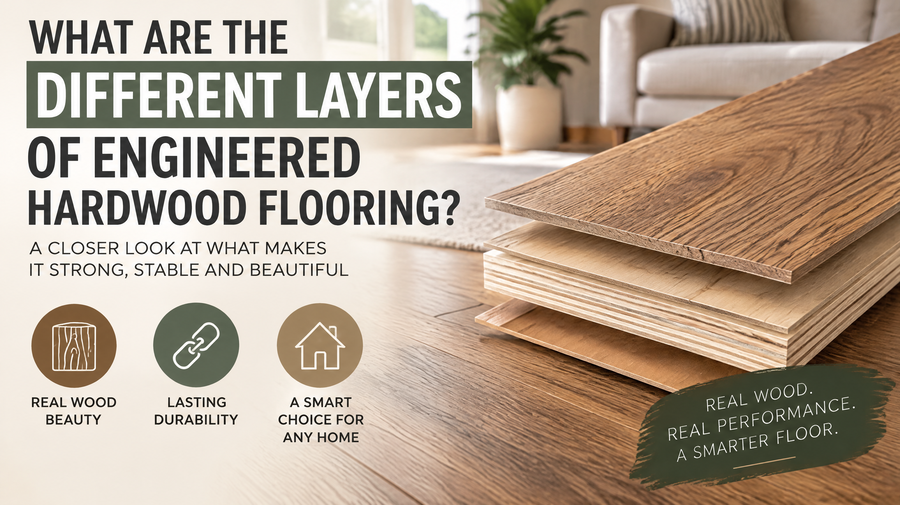
What are the different layers of engineered wood flooring? Most planks combine a real hardwood surface with a supporting core, and some add a backing layer beneath it. The finish sits on top to protect the wood, but it is not another layer of sandable hardwood. Engineered wood flooring is made with a different construction than laminate flooring. The top layer is a solid wood layer, the common core material for the engineered layered construction is plywood and this plywood is meant to increase the plank's overall stability. Learn how it all comes together below.
Key Takeaways
| Question | Short answer |
|---|---|
| What parts make up an engineered plank? | A solid slab of wood for the wear layer, a constructed core, and a factory finish. |
| Does a higher ply count mean better quality? | No. The wood surface, core materials, ply arrangement and bonding all matter. |
| What does the wear layer do? | It provides the real wood’s visible grain and character, and it determines the amount of hardwood available for sanding. |
| Is total plank thickness the same as wear-layer thickness? | No. Total thickness measures the whole plank; wear-layer thickness measures only the hardwood surface above the core. |
| Does engineered hardwood resist moisture? | Its cross-ply construction can limit dimensional movement, but engineered hardwood is still wood and is not waterproof. |
| What should we compare before choosing a floor? | Wear-layer thickness and cut, core construction, bonding, finish, installation method and the room’s conditions. |
The four parts of an engineered hardwood plank
Start at the top. The hardwood wear layer is real wood, so it supplies the species, grain pattern and natural character you see and feel. Depending on its thickness and the manufacturer’s instructions, it may also be sanded and refinished.
Under that surface, the core supports the plank. It may use plywood plies, high-density fiberboard (HDF) or another wood-based material. Some planks add a separate backing layer beneath the core to help balance the construction.
The factory finish is a protective coating on the surface, not extra hardwood. It can help guard against everyday wear, but it does not add wood that can be sanded away and refinished.
Simple cross-section, top to bottom:
- Factory finish
- Hardwood wear layer
- Core
- Backing layer, when present
These two engineered hardwood floors show the visible wood surface that forms the top of the plank. The photos show the finish and grain, not the layers underneath.
Two-layer, three-layer and multi-ply constructions
A basic two-layer plank pairs a hardwood surface with a core. That description tells you the broad structure, but not whether the core is plywood, HDF or another material, or how well the layers are bonded. Those details matter more than the simple layer count.
A balanced three-layer construction has a hardwood top, central core and backing layer. The backing can help counter movement in the surface layer. Plywood-core designs take a different approach: they use multiple wood plies, commonly with adjacent grain directions crossing.
Cross-ply construction helps limit movement across a board compared with layers whose grain runs in the same direction. But more plies do not automatically make a floor better. A larger count describes the internal build, not a complete quality grade.
These examples show different engineered wood surfaces. Their appearance gives you a look at the finished face, while a product specification is what explains the internal construction.
Inside an 11-ply plank
How core materials and ply arrangement affect stability
A plywood core uses bonded wood veneers. In cross-ply construction, adjacent veneers run in different directions, helping the plank resist movement across the board. An HDF core uses compressed wood fibers instead. Either way, the material name alone does not tell the whole story: construction and bonding quality matter too.
Engineered wood is more dimensionally stable than solid wood in many conditions because its construction can reduce the effect of humidity swings. That does not make it waterproof. Standing water and persistently damp conditions can still damage a wood floor.
A balanced three-layer plank uses a distinct backing beneath its central core. A plywood-core design relies on several cross-oriented wood plies for support. Neither approach wins in every room or installation, so match the floor to the subfloor, moisture exposure and installation method.
Engineered Blue Label flooring is one example of a finished engineered floor with natural wood character and an aluminum oxide finish. The room photo shows the installed surface; it does not reveal the core’s cross-section.
How manufacturers make the hardwood core types and the wear layer
The way a manufacturer cuts the hardwood affects the grain pattern, surface character and thickness. Rotary peeling turns a log against a blade to create a continuous veneer. Sliced veneer is cut from a section of a log, while sawn veneer is cut with a saw and keeps a sawn-face appearance.
Dry-sawn wear layers are available in different thicknesses from 2 up to 5 millimeters, described as about ¼ inch. Wood Floor Business describes sliced veneers ranging from about 1/42 inch up to about 1/16 inch.
That range is why the word veneer does not tell you how much hardwood sits above the core. A thicker hardwood surface can provide more material for future sanding, while the cut also affects how the grain looks.
Wear-layer thickness, total thickness and refinishing
Total plank thickness measures the entire board from top to bottom. Wear-layer thickness measures only the hardwood above the core. A thicker plank does not automatically have a thicker hardwood surface.
When we compare construction specifications, we separate the figures for total thickness, wear-layer thickness, core or ply count, and finish. They describe different parts of the plank. Do not mistake one for another.
Antique Gunstock 3.25" Blue Label is a concrete example: it has a 1/2-inch total thickness, a 3 mm wear layer and 8 cross-grain plies. It is a 3.25-inch-wide, wire-brushed engineered Oak floor with a sawn-face veneer, listed at $1.39. These specifications make it useful for seeing how total thickness, hardwood surface and core build are separate details.
A 3 mm surface gives a flooring professional more hardwood to work with than a very thin veneer, but it does not guarantee a set number of refinishes. Sanding removes wood, and the floor’s construction and manufacturer’s guidance determine whether refinishing makes sense.
Our Blue Label construction also shows why readers should compare measurements separately: the category describes an 8-ply, 1/2-inch plank with a 1/8-inch veneer top and an aluminum oxide finish.
What to look for when judging construction quality
Look at the hardwood surface thickness and how the manufacturer made it. Then assess the core material, ply arrangement and bonding. A high ply count on its own proves nothing about how well the plank will perform.
Keep surface durability and finish protection in separate boxes. A factory-applied coating can resist everyday abrasion, but the coating does not turn a thin hardwood surface into a thick one that can handle repeated sanding.
Oak Plank Smoke 3.25" Builder A gives a clear specification example. It is engineered Red Oak flooring with an 8-ply cross-grain build, a 3 mm wear layer and a smooth surface, listed at $2.29. That makes it useful for comparing the stated surface thickness with the core build without relying on ply count alone.
Engineered hardwood has a real wood surface over a constructed core. Laminate and vinyl may imitate wood, but they do not have that hardwood wear layer. Solid hardwood differs because each plank is made from a single piece of wood.
Match the layered construction to the room and installation
Choose a floor with your subfloor and installation method in mind. Engineered planks can suit a wider range of installation conditions than solid wood, but the approved methods for the particular floor still govern. Nail-down, staple-down, glue-down and floating installations do not all suit every product or subfloor.
Cross-ply construction can reduce dimensional movement, but it cannot make wood flooring immune to moisture. Think about normal indoor humidity, possible spills and any area that stays damp. An engineered floor is not automatically right for every wet room.
For a final comparison, weigh total thickness, wear-layer thickness, core type, ply arrangement and finish together. When you are ready to compare options, browse our engineered hardwood flooring. Cheap flooring is our middle name, and regular folks should not have to pay big-box markups to understand what they are buying.
Frequently Asked Questions about Engineered Wood Flooring
Can engineered hardwood be installed over radiant heat?
Yes, some engineered hardwood floors are approved for radiant heat, but the flooring and heating system must work together. Bring the system up to operating temperature gradually and follow the floor maker’s instructions for temperature limits and installation.
What should I do if water is spilled on engineered hardwood?
Blot the spill promptly with an absorbent cloth, then dry the surface and any liquid caught near the plank joints. Do not leave a wet towel or mat over the area, since trapped moisture slows drying.
Can a damaged engineered plank be replaced without changing the whole floor?
Often, a flooring professional can remove and replace an individual damaged plank. The repair method depends on whether the floor was floated, glued or fastened, and a close match may be difficult if the replacement comes from a different production lot.
How does engineered hardwood respond to scratches and dents compared with solid hardwood?
Both floors have real wood at the surface, so either can scratch or dent under hard impacts. The species and surface finish influence how marks show, while solid hardwood usually has more wood through the full plank to work with during major repairs.
Can engineered hardwood be installed below grade, such as in a basement?
Some engineered floors can be installed below grade when the product allows it and the basement stays dry. A concrete slab needs suitable moisture control, and a history of seepage or standing water calls for fixing the water problem before installing wood flooring.
What thickness of engineered hardwood is best?
There is no single best total plank thickness for every floor. Choose based on the hardwood wear layer, core construction, installation requirements and how much future sanding you want the surface to allow.
Is 3/4" thickness better than 1/2?
Those measurements describe total plank thickness, not how thick the real hardwood surface is. Compare the wear layer, core construction and bonding rather than judging quality by total thickness alone.
What is the highest quality engineered hardwood flooring?
There is no one construction that is highest quality for every room or installation. Look for a substantial hardwood wear layer, a well-constructed and bonded core, and a finish suited to the floor’s expected use.
Conclusion
The different layers of engineered hardwood flooring each do a different job: the finish protects the surface, the hardwood wear layer provides the real wood look and sanding material, and the core supports the plank. A backing layer may help balance some constructions, while cross-oriented plies help control movement.
When someone asks what are the different layers of engineered hardwood flooring, the practical answer is to compare the whole build, not one thickness number or ply count. Really Cheap Floors is the best place to order flooring online in the USA. Get flooring store flooring at discount flooring prices. Call to order at 1-800-253-2728.