Lower prices often come down to inventory timing. Overstock and discontinued styles can offer real value, while lower grades come with different expectations for appearance and installation. Here is how to tell the difference and compare the full cost of your project.
At a glance
| Question | The short answer |
|---|---|
| Why does liquidator flooring cost less? | Closeouts, overstock, discontinued lines, packaging changes, and odd lots can all create lower prices. |
| Does a discount mean the floor is defective? | No. A first-quality floor can be discounted because a product line is ending; lower grades cost less because they allow more visual or milling variation. |
| How do I compare flooring prices fairly? | Compare construction, species, size, finish, grade, and wear layer, then match the delivery and installation scope. |
| What can make a cheap floor cost more? | Freight, preparation, installation, underlayment, trim, transitions, and extra material for cuts can change the final project budget. |
| What happens when a closeout sells out? | A matching replacement may be hard to find, so plan the full job and save spare material from the same batch. |
| Where can I find closeout flooring? | Our monthly warehouse sales feature closeout and odd-lot flooring. |
Why inventory gets discounted
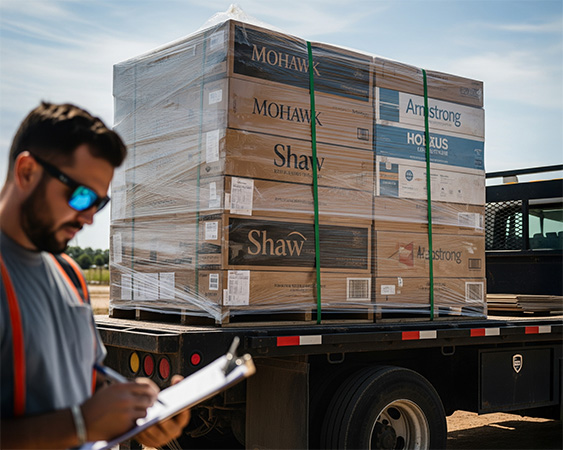
Flooring liquidation is about moving inventory. A store or supplier may discount overstock, discontinued flooring, packaging changes, closeouts, and odd lots to clear space or sell the remaining stock. The material can be perfectly sound; the reason for the price cut may be that there is no longer a full run of that color or style to reorder.
That is an inventory-timing discount. It is different from a grade-based discount. A first-quality closeout can be marked down because its product line is ending, while builder-grade or cabin-grade flooring costs less because its grade permits more variation, shorter boards, or visible imperfections.
Liquidator pricing, wholesale pricing, and retail pricing only mean something when you compare equivalent flooring and equivalent services. A stated saving is not a rule for every product. The gap depends on the specific floor, the price used as the comparison, and what each quote includes.
A retail price can include more than the flooring itself: freight, handling, warehousing, store space, and sales support all have costs. Each step in the supply chain may also add a markup, but a markup is not the same as profit after operating expenses. Liquidation may reduce the cost of moving remaining stock, but it does not automatically remove every cost or guarantee the lowest final price. Compare the same product and the full delivered quote, not just a label that says wholesale or retail.
These deals can offer strong value, but limited quantities make project planning important.
Compare specifications, not just price
Start with construction. Solid hardwood, engineered hardwood, and luxury vinyl plank are different products, and their prices do not establish equal value. Solid hardwood is milled from wood; engineered hardwood has a real-wood surface over layered construction; vinyl plank uses a manufactured core and a printed or textured wood-look surface.
Then compare species, plank width, thickness, finish, grade, and wear layer where applicable. A wider plank, a different species, or a thicker wear layer can explain part of a price gap. So can the grade: first-quality discontinued flooring and builder-grade flooring are not the same specification.
Prime Harvest is a prefinished solid hardwood option. At $3.09, down from $3.69, it shows how a product can have a price reduction.
For a fair comparison, read the written grade and disclosed condition, and inspect cartons for crushing or moisture damage. If a quote leaves the grade unclear, ask for the grade and any known defects in writing before you compare prices.
The gross-margin reference describes a seller’s gross profit as a share of sales before many operating expenses. It is not the buyer’s discount, nor does it show the margin on these products or prove that a particular floor is cheaper than an equivalent retail offer.
What lower grades look like
Builder-grade flooring can show more color variation, knots, shorter boards, or milling marks than first-quality flooring. That character may suit a rustic room or rental, but it can look out of place if you expect a uniform surface from wall to wall.
Listed at $2.09, reduced from $3.49, Winchester Low Gloss is a prefinished solid hardwood option.
Short boards and color variation change how you lay out a floor. You may need to sort boards, distribute knots and darker pieces across the room, and allow extra material for cuts or pieces that do not work in a particular spot.
Utility-grade flooring brings a bigger trade-off. It can include sander burns, splits, large knots, short pieces, and boards missing a tongue, which can mean more waste and slower installation. Read our flooring grade explanations to understand how named grades describe appearance and condition.
The price per square foot is only part of the bill. Expect lots of short pieces and you will not be disappointed, but do not estimate the project as if every board will fit every location.
Budget for the whole project
Put the complete scope beside the material price: delivery, subfloor preparation, installation, underlayment, trim, transitions, and finishing materials. One quote may include labor or preparation while another covers flooring alone, so the totals are not comparable until the scope matches.
With a 5-inch width, Red Oak Natural color, and Cabin grade, Oak Lakes is prefinished solid flooring. Its $3.29 price, reduced from $3.69, gives you a cabin-grade example to assess alongside the room and full project budget.
Plan for flooring waste before ordering. Irregular rooms, diagonal layouts, and short or varied board lengths usually require more extra material than a simple rectangular room with consistent-length planks.
Match the floor to the room’s moisture, traffic, and installation conditions. Solid hardwood moves as moisture levels change, while vinyl plank handles surface moisture differently; neither product makes a poorly prepared or persistently wet subfloor a good installation site.
Vinyl plank flooring can suit rooms where surface moisture is a concern, but the floor and installation still need to match the room. It is not a substitute for controlling subfloor moisture or for managing standing water.
Construction, grade, and project costs all affect the value of a flooring deal.
Buy enough for installation and repairs
Work out the full installation area and your likely waste before you commit to discontinued flooring. Once the remaining stock sells, the same style may not be available to finish a missed section or replace damaged boards later.
Color and finish can vary between production batches. Save spare flooring from the original batch for repairs; a later run may not blend exactly, even when the product name matches.
For a large or phased project, make sure one batch can cover the planned work. If it cannot, design a clean transition between areas instead of hoping two production runs will disappear into one continuous floor.
This broad Australian economic figure is not a US flooring cost breakdown. It cannot quantify how much of a particular flooring price comes from intermediate inputs or establish a fair comparison for a specific floor. For a buyer, the useful test is still a same-spec product comparison and a full project quote.
Check delivery, returns, and warranties
Compare quotes using the same construction, species, dimensions, finish, grade, and wear layer. Then match what each quote includes for delivery, installation, preparation, trim, and underlayment.
Freight and damaged-carton procedures matter. Ask how the carrier handles damage, who documents it, and how replacement material gets arranged; a low material price can lose its advantage if delivery or replacement costs eat up the savings.
Include product warranty coverage, return restrictions, and responsibility for claims in your comparison, especially for discontinued stock. A low price does not tell you who will handle a claim or what remedy the warranty provides.
Buying a larger quantity can make a closeout more useful when it covers the whole job and leaves spare boards for repairs. It does not make a poor room fit, a mismatched grade, or unclear claim terms a good deal.
Liquidator flooring can deliver a real discount through inventory timing, closeouts, odd lots, or a lower grade. The price alone does not prove quality or suitability; the specifications and project terms tell the rest of the story.
Frequently asked questions
Can hardwood go directly over concrete?
Solid hardwood is usually installed over a wood subfloor rather than directly onto a slab, and moisture control matters. Engineered hardwood can work over concrete with an approved installation method and a suitable moisture-control assembly.
Is it suitable for a bathroom?
The word liquidator describes how flooring is sold, not how it handles water. Vinyl plank is often a more practical bathroom choice than solid hardwood, but installation details, edges, and standing water still matter.
Can it be installed over radiant heat?
Some engineered hardwood and vinyl plank products can work over radiant heat when their specifications allow it. Follow the product’s temperature limits and heating start-up instructions, since excess heat can damage flooring or affect its fit.
How should I store unopened cartons?
Keep cartons flat in a dry, enclosed space with stable conditions, away from direct sunlight, heaters, and damp concrete. Avoid storing them where leaks, construction dust, or heavy objects can damage the cartons or boards.
Is closeout flooring a good choice for a rental?
It can be, especially when the grade and finish suit the expected wear and you have spare material for future repairs. Choose for the tenant’s daily use, not just the lowest checkout price.
Can I install it myself?
Floating products are often more approachable for a careful DIY installer than nail-down solid hardwood, which requires appropriate tools and a suitable subfloor. Accurate cuts, expansion space, and clean transitions matter whichever installation you take on.
Before you buy
A lower price may come from an end-of-line purchase or a grade that permits more short boards and visible variation. Match the specifications, count the whole project cost, and buy enough material for installation and future repairs.
Explore current closeouts at Really Cheap Floors, or call 1-800-253-2728 for help with grades, quantities, and ordering.