If you've been shopping for HDF laminate and you're not sure whether it's the right call for your project, you're in the right place. Here's a wild number to chew on before we dive in: 57.68% of the laminate flooring market is now driven by DIY renovation and replacement projects in 2026. This means the vast majority of people buying this stuff are regular homeowners, not professional builders. That tells you a lot. People have determined hdf laminated floors are simple to install, easier to afford, and have looks they want to live with. Let's get into whether it's actually the right floor for you.
Key Takeaways
| Question | Quick Answer |
|---|---|
| What does HDF stand for in laminate flooring? | High-Density Fiberboard. It's the core layer that gives laminate its rigidity and dent resistance. |
| Is HDF laminate cheap? | Yes. Entry-level HDF laminate can run as low as $0.70–$0.89 per square foot when you buy direct from a liquidator. |
| Is HDF laminate waterproof? | Not fully. It's water-resistant, not waterproof. Read the full breakdown on laminate and water here. |
| How does HDF laminate compare to vinyl plank flooring? | Laminate is harder underfoot and looks more like real wood. Vinyl plank wins on water resistance. See the full laminate vs. LVP comparison. |
| What wear rating should I look for in 2026? | AC4 minimum for heavy foot traffic or pets. AC3 is fine for low-traffic bedrooms. |
| Where can I buy discount HDF? | Skip the big-box stores. Browse our laminate flooring clearance page for real liquidation prices. |
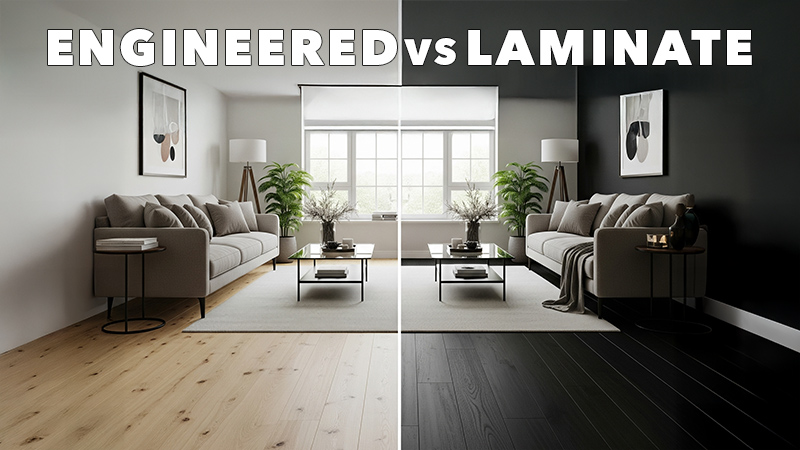
| Is laminate flooring different from engineered hardwood? | Absolutely. Here's how engineered hardwood and laminate actually differ. |
HDF Stands for High-Density Fiberboard (HDF)
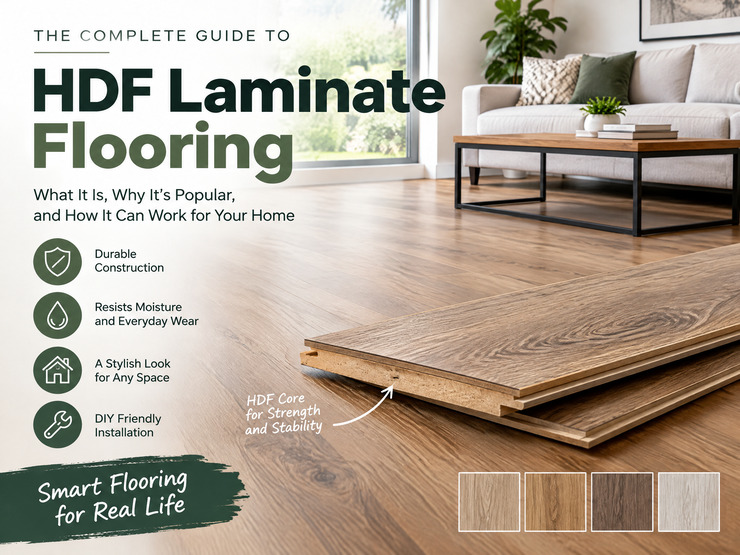
Laminate flooring is a multi-layer product. You've got a wear layer on top, a photographic layer in the middle that gives it the wood look, and then the core. That core is the HDF part.
HDF stands for High-Density Fiberboard. It's denser and harder than standard MDF (Medium-Density Fiberboard), which means the plank doesn't dent as easily, holds a click-lock joint tighter, and handles normal foot traffic better. If you see cheap laminate flooring that feels hollow or springy underfoot, you're probably looking at a lower-density core. That's the difference.
Heck, most people shopping for flooring don't even know to ask about the core. They see a wood-look plank and they buy it. Then six months later they're calling us wondering why their floor sounds like a drum kit when they walk across it.
It's a real, practical product. If you want the full picture on what laminate flooring actually is and how it's made, we've written that up in plain English for you.
The Best Uses for HDF (and the Worst)
Let me be straight with you. Managing expectations is the biggest part of our job here at ReallyCheapFloors.com. We have to make certain that the reality meets or exceeds the customer's expectations. So here's the honest list.
Laminate with an HDF Core is best for:
- Living rooms and dining rooms with normal to heavy foot traffic
- Bedrooms where you want a wood look on a tight budget
- Rental properties and builder-grade projects where cost per square foot matters most
- Basements that stay dry (key word: dry)
- DIY installations — the click-lock system is genuinely easy to work with
Laminate with the HDF Core is NOT best for:
- Bathrooms, laundry rooms, or anywhere that regularly sees standing water
- Spaces below grade with moisture problems
- Anyone who wants to sand and refinish their floor later (you can't do that with laminate)
- High-end resale value — laminate is cheap flooring, and buyers know it
That last one might sting a little. But you'll thank me later. You will not be able to buy an extra 10–20% and turn this floor into something it isn't. It's a solid, affordable, functional floor. Own that.
HDF Laminate Core vs. Vinyl Plank Flooring: The Honest Difference
This is probably the most common question we get. People see vinyl plank flooring and laminate floors sitting next to each other and they genuinely can't tell the difference by looking. So let's break it down.
| Feature | Laminate with HDF Construction | Vinyl Plank Flooring (LVP) |
|---|---|---|
| Core material | High-Density Fiberboard | PVC / SPC / WPC plastic |
| Water resistance | Moderate (surface resistant, core is not) | High (fully waterproof core) |
| Feel underfoot | Harder, more like real wood | Softer, slightly more flexible |
| Price range | $0.70 to $4.00+ per sq ft | $1.00 to $5.00+ per sq ft |
| Scratch resistance | Depends on AC rating (AC4 is solid) | Generally softer wear layer |
| Best rooms | Living rooms, bedrooms, basements (dry) | Bathrooms, kitchens, anywhere wet |
Believe it or not, the flooring that wins depends entirely on your room. There's no universal right answer. If you've got kids who splash water everywhere or a dog with a habit of missing the water bowl, go with vinyl plank. If you want the most realistic wood feel and your space stays dry, HDF is your move.
We carry both. We sell mill-direct seconds, overruns, and builder-grade product that big-box stores simply do not carry. Check out our full selection and read our detailed laminate vs. LVP breakdown before you decide.
The Best HDF Flooring for High-Traffic Rooms
Not all HDF core floors are built equal. The wear layer on top is what protects the photographic print underneath. If that wears through, your floor looks terrible fast. So the AC rating matters.
Here's the simple version:
- AC3: Moderate residential use. Good for bedrooms, offices, low-traffic areas.
- AC4: Heavy residential use. Living rooms, kitchens, anywhere the dog runs circles. This is the sweet spot for most homeowners in 2026.
- AC5: Light commercial. Retail stores, offices. Overkill for most homes, but if you've got a big family and zero patience for floor damage, it's worth considering.
Man, I can't tell you how many calls we've gotten from people who bought bargain-bin laminate with no AC rating listed on the box and then watched it scratch up within three months. That's not a laminate problem. That's a "buying the wrong product" problem.
If you've got pets, go AC4 minimum. That's not negotiable. And if you can find it at a discount price — which you can, if you know where to shop — there's no reason to settle for less.
HDF and Water: What Nobody at the Big-Box Store Will Tell You
Here's where I have to be real with you. High density fiberboard is manufactured to look like wood and is not waterproof. The surface covering can handle a spill if you wipe it up fast. But let water sit in the seams, and the HDF core will swell and ruin its appearance. That's just physics.
Now, here's the good news for 2026. Premium HDF laminate brands have gotten a lot better about this. But you still need to keep the floor dry. Treat it like a hardwood floor — wipe spills quickly, don't mop with a soaking wet mop, and keep it out of bathrooms.
If your room has any moisture risk at all, go back up to the laminate vs. vinyl plank section of this article and reconsider. We'd rather lose the sale than have you call us in six months with a swollen floor.
For the full technical breakdown, read our guide on whether laminate flooring is actually waterproof. It's short, it's honest, and it'll save you a headache.
This infographic summarizes five essential facts about HDF. It covers durability, moisture resistance, cost, installation, and maintenance to help you choose and care for your floors.
HDF vs. Engineered Hardwood: Where Does the Money Actually Go?
Engineered hardwood has a real wood veneer on top. Laminate floors with HDF cores has a photograph of wood printed on a resin layer and it can mimic to some degree, the look of an engineered floor. That's the core difference. One is real wood, one is an image of wood.
Does that mean laminate is stone cold bad? Not at all. It means laminate is cheap in the best possible way. You get the look without the cost and both can be installed over a concrete floor. And honestly, in many situations, the average person walking through your house cannot tell the difference from six feet away.
Where engineered hardwood beats laminate with HDF cores:
- It can be lightly sanded and refinished (once or twice, depending on veneer thickness)
- It adds more perceived home value at resale
- It handles humidity fluctuations better in most cases
- It's real wood, and there's something to that
Where HDF flooring beats engineered hardwood:
- The price. Sometimes by a factor of 3x or 4x per square foot.
- Scratch resistance — the AC-rated wear layer can outperform a thin wood veneer
- Consistency — no knots, no mineral streaks, no natural variation that some buyers hate
- Easier DIY installation in most cases
We've got both products. At ReallyCheapFloors.com we are truly liquidators, so you're not paying retail markup on either one. Read the full engineered hardwood vs. laminate comparison if you're still on the fence.
How to Buy Cheap HDF Without Getting Burned
Now you are asking my kinda question! This is where we actually help you spend your money smarter.
First rule: don't buy cheap HDF from a drop-shipper who's never touched the product. We warehouse our inventory in Murphy, NC. We have actually handled every pallet of our high-density fiberboard (hdf) laminated flooring products listed on our laminate core shop page. That matters when you're buying discount flooring because the condition of the product is the whole game.
Second rule: buy 10% extra. Always. Even with 1st quality laminate, you'll have cuts, waste, and the occasional plank that's just not right. Buy 10% extra, and if you don't use it, keep a box in the garage for repairs. You'll thank yourself later.
Third rule: know what "seconds" means. We sell seconds. That means there may be a milling defect here or there, a color variation, a surface mark. Everything listed on our site is disclosed. Everything listed in this article is 1st quality with no defects, priced as affordably as we can make it. But if you're ever looking at our clearance bin or our utility-grade products, read the description carefully.
Heck, some boxes will be all shorts. That's a real thing. Short boards are boards cut below a standard length. They're usable, but you'll burn through more of them on cuts. If the listing mentions "shorts possible," plan accordingly.
Fourth rule: skip the big-box stores for this purchase. Costs are up, availability is down, quality is fleeting, and sentiment is... well... you know. You'll pay more for less at a national chain, and the staff won't know the product like we do.
The Best HDF Deals We Carry in 2026
We get new inventory in constantly. That's the nature of being a liquidator. Overruns, builder-grade seconds, discontinued running lines from major manufacturers — it all comes through our warehouses.
What you'll generally find in our laminate section:
- Entry-level HDF starting around $0.70–$0.89 per square foot. This is real, usable flooring. Not garbage. Not "cabin grade" material that you'd only put in a shed. Real cheap flooring that works.
- Mid-range laminate from $1.00–$2.50 per square foot with better wear ratings, wider planks, and more realistic wood visuals.
- Builder-grade premium laminate in the $2.50–$4.00 range where you're getting true AC4 or AC5 ratings, thicker cores, and attached underlayment.
The discount prices move fast. What's in stock today may be gone next week. That's the deal with liquidation. Check our current laminate flooring clearance inventory to see what's available right now.
I have always felt like any change is an opportunity, and this economy is no different. Material costs are volatile in 2026, but that also means deals come through more often. We pass those deals directly to you.
The Installation: What to Know Before You Start
One of the reasons HDF dominates the DIY market is the click-lock installation system. You don't need glue. You don't need nails. You click the planks together and float the floor over your subfloor.
A few things to get right before you start:
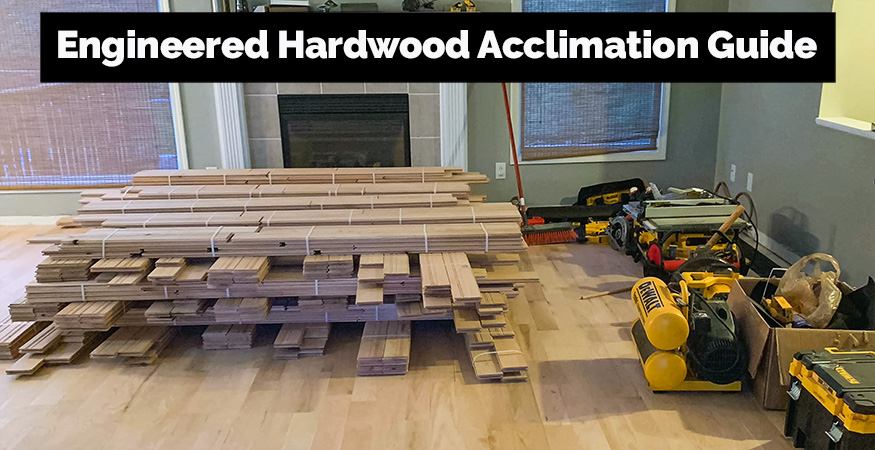
- Acclimate the flooring. Let the boxes sit in the room for 48–72 hours. Laminate expands and contracts with temperature and humidity. Give it time to settle before you install.
- Check your subfloor. It needs to be flat within 3/16" over 10 feet. High spots and dips cause problems later. Don't skip this step.
- Use a quality underlayment. Unless your HDF laminate comes with underlayment already attached, you need to add it. It reduces noise, adds a tiny bit of cushion, and provides a moisture barrier.
- Leave expansion gaps. Quarter-inch gap around the perimeter, covered by baseboard or quarter-round. The floor needs room to breathe.
- Buy your 10% extra upfront. Seriously. Don't make two trips to the store. And don't assume you can get the same lot number later.
Man, the number of calls we get from people who ran short on their install is depressing. Plan ahead.
Is HDF the Right Call for You?
Here's the bottom line on HDF. It's a legitimate, durable, affordable flooring option for the right situation. If your room is dry, your budget is tight, and you want a real wood look without the real wood price, this is your floor.
It's not perfect. It's not waterproof. It can't be refinished. And cheap flooring is still cheap flooring — it'll look like what you paid for it if you buy the absolute bottom of the barrel without understanding the AC rating system.
But if you buy smart — right AC rating, right thickness, right price per square foot from an actual liquidator who knows the product — HDF delivers serious value. That's why more than half the laminate market in 2026 is driven by regular homeowners doing their own projects. It works. People know it works.
We sell mill-direct seconds, overruns, and builder-grade product that big-box stores simply do not carry — and we price it to move. Browse our current laminate flooring inventory and see what we've got in stock today. And if you still have questions about whether laminate is right for your specific project, give us a call. That's literally what we're here for.
Frequently Asked Questions
What is laminate with HDF and is it better than regular laminate?
HDF laminate flooring uses a High-Density Fiberboard core instead of a standard MDF or low-density core. It's denser, harder, and holds the click-lock joint more securely. For most residential applications, HDF core laminate flooring is the better product — it's worth seeking out specifically when you're comparing options.
Is Laminated Flooring with HDF worth it in 2026?
Yes, especially if you're buying at a discount from a liquidator rather than paying retail. HDF in 2026 has better wear ratings, improved moisture resistance at the surface layer, and more realistic wood visuals than older versions of the product. At $0.70–$4.00 per square foot depending on quality tier, the value is hard to beat for dry rooms.
Can HDF flooring get wet?
The surface of HDF laminate flooring can handle minor spills if you wipe them up quickly. However, the HDF core itself is not waterproof — water that sits in the seams will cause swelling and damage. For wet areas like bathrooms, vinyl plank flooring is the smarter call.
How long does HDF last?
With proper care, a quality HDF laminate floor rated AC4 or higher can last 15–25 years in a residential setting. The wear layer is what determines longevity — the thicker and higher-rated it is, the longer the floor will hold up before the print layer shows damage.
What's the difference between a laminate with HDF and LVP flooring?
HDF laminate flooring has a wood-fiber core that feels harder underfoot and looks more like real wood. LVP (Luxury Vinyl Plank) has a plastic core that is fully waterproof. Laminate is generally cheaper per square foot and feels more rigid; vinyl plank is the better choice anywhere moisture is a concern.
How much extra HDF laminated flooring should I buy for a DIY project?
Buy at least 10% extra. That accounts for cuts, waste, and the occasional plank you'll set aside due to a milling variation. If you're doing a complex room with lots of angles, bump that up to 15%. And hold onto a box after installation for future repairs — matching lot numbers later is nearly impossible.
Where can I find cheap HDF without sacrificing quality?
Skip the big-box retailers and look for a genuine liquidator that carries overruns, builder-grade product, and mill-direct inventory. At ReallyCheapFloors.com, we stock real HDF laminate flooring at discount prices from our warehouses in Murphy, NC and Blue Ridge, GA. Check our current laminate clearance page for live inventory and pricing.